

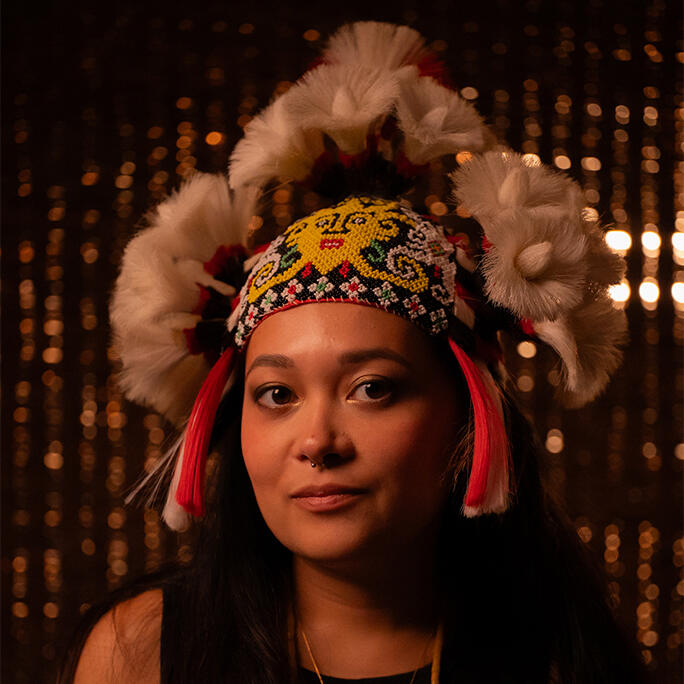
Nun dengah! My name is Bethany Luhong Balan, but you can call me Bee.
I'm a freelance multimedia designer, poet, and self-taught visual artist from Kuching, Sarawak. I have a bachelor degree in graphic design and I've been involved in creative ventures in one way or another for as long as I can remember; I've participated in various spoken word performances, contributed to poetry anthologies and art exhibitions, and even took part in a virtual artist residency.As a multi-disciplinary artist, I approach my work in a playful and subversive way, invoking a sense of magic realism to each piece, whether the medium is embroidery, poetry, clay, or digital art.
Visual Art

ASAP (2026)

Ingen (2024)

Tanah & Air (2024)

Burning Out But
At Least I'm
Burning (2023)
(H)ARUS I, II, & III (2022)

Hudo' II (2022)

Hudo' I (2021)
<< back to Gallery
take the Virtual Tour >>

ASAP (2026)
Mixed Media

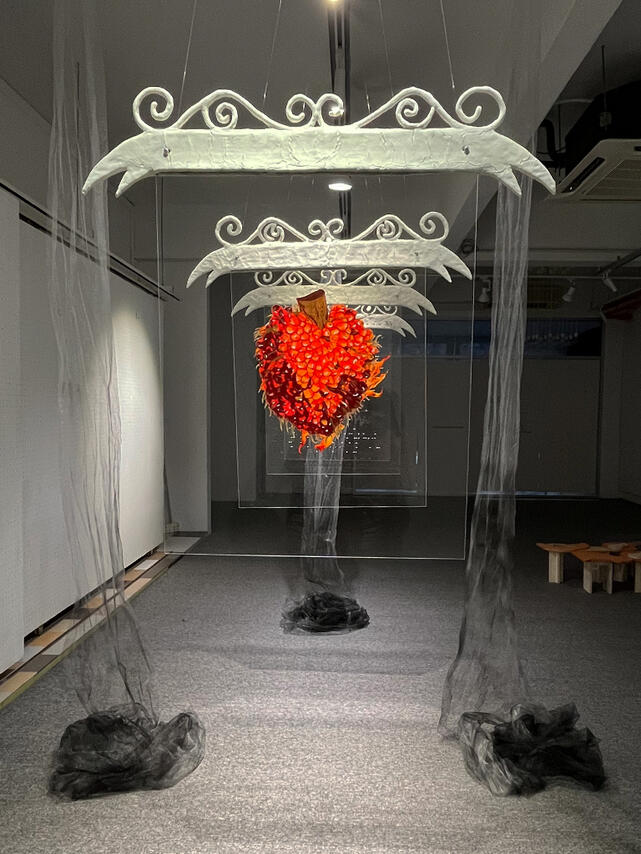
This work consists of a series of transparent acrylic panes arranged one in front of the other in a line. They are suspended from the ceiling by frames made from air dry clay depicting a motif of the Rhinoceros Hornbill, one of the most esteemed omen birds of the Dayak people. Each pane represents a separate era of agriculture. On the first pane, grains of rice are neatly arranged, followed by a second pane of pepper corns. The third pane, a painting of fire and ash, and on the last pane, a painting of an oil palm cluster. All these seasons of growth and destruction are surrounded by five banners of tulle, painted in an ombre of grey and white—dark and smoky where they touch the ground, slowly fading as they ascend upwards. Accompanying this tableau is a spoken word piece: my voice reciting the morse code formed by the dots and dashes of pepper and rice.My people had an ancient and spiritual connection with rice, but I personally have never witnessed a time when we farmed it. When I was a child, we cultivated mostly black pepper, not rice. But now, my younger nieces and nephews have never seen my grandmother come home with a basket full of black pepper, they’ve never seen her separate the little berries from the branches and lay them out in the sun to dry. They have only known a time where the road to our longhouse is surrounded by an endless sea of oil palm trees, as far as the eye can see. How does time dictate the crops we choose to cultivate, and how we choose to cultivate them? I discussed this with Thomas Smith, Associate Professor in Environmental Geography, and what he shared horrified and galvanised me—we talked about the smouldering, persistent peatland fires, the destruction wrought in the wake of ever more palm oil plantations, the indelible effect it had on our normally temperate and predictable planting seasons. It left me with more questions than answers, but one in particular kept pushing its way to the surface: what can we glean from looking back through the layers of our history? Mere data? Numbers and facts? Statistics that spell out a warning? Or perhaps a story of a time when planting a seed was about feeding what fed you, taking only what you needed, and putting the rest back into the soil.


<< back to Gallery

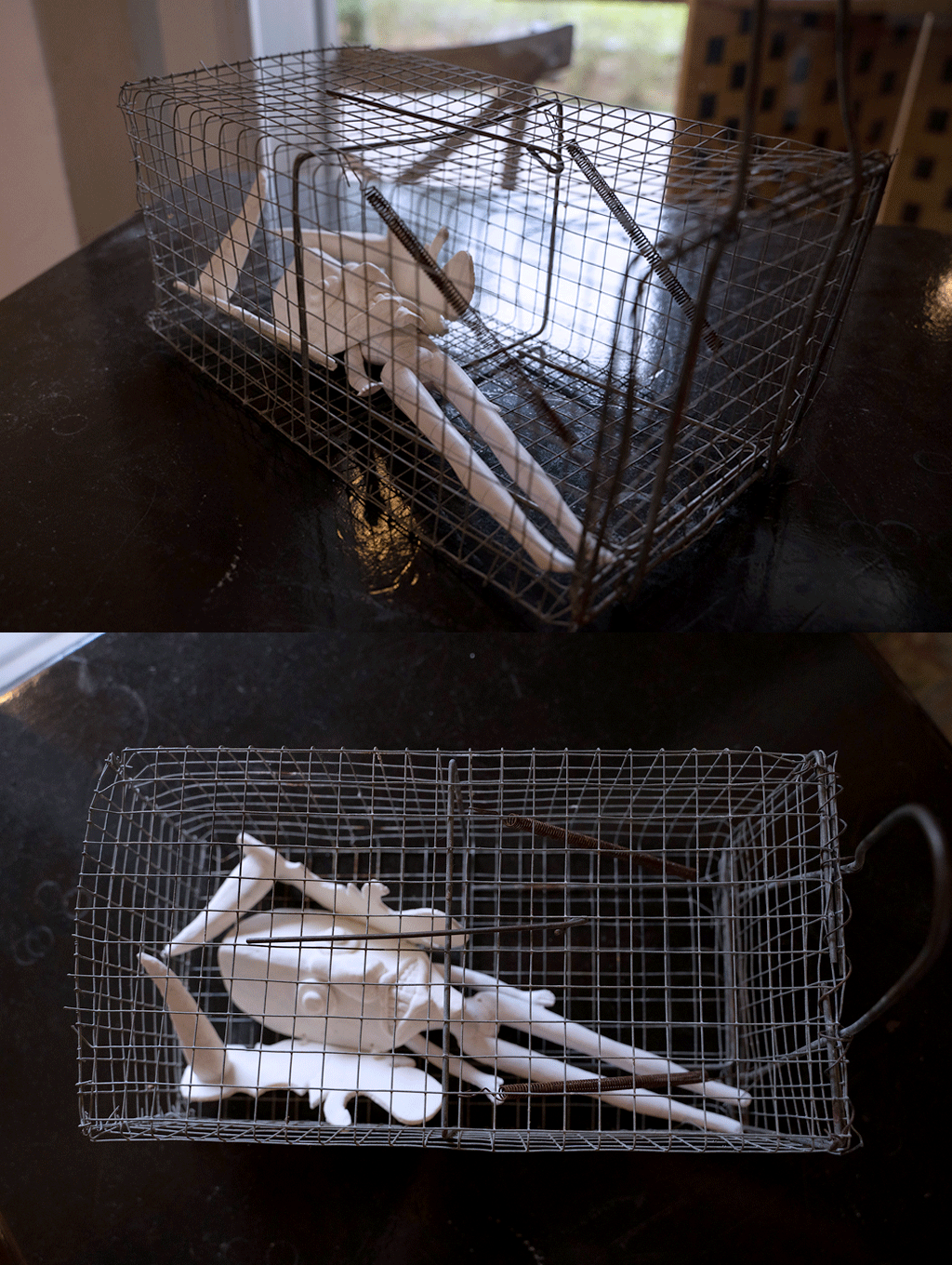
Ingen (2024)
Mixed Media, 85cm x 182cm

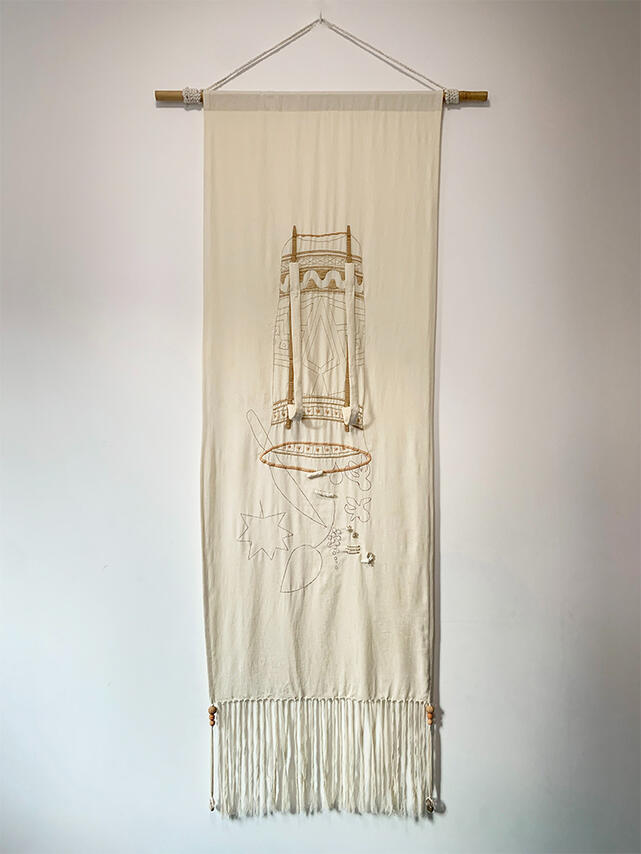
This piece explores the future of humanity and how it relates to the environment. As a Kayan person, I believe that the natural world is inseparable from culture, so in a conversation about climate change, we have to speak about Indigenous heritage as well. We are losing Indigenous knowledge, we are losing recipes for environmental stewardship. The empty, upended ingen—the Kayan word for a big woven basket used to carry produce back from the farm—with brittle bones and crude imitations of bounty spilling out of it was how I captured this anxiety about the future of humanity. The embroidery thread, which I dyed with onion skin, roselle flowers, and coffee, will eventually fade. The little jars of dirt anchoring the tapestry on the left and right: Santubong to the West, Sungai Asap to the East. Unglazed beads from Lawas, raw and incomplete. Crude depictions of durian, engkabang, black pepper; almost as if the artist was trying to draw them based on second hand accounts instead of real life—each of these elements reflects the anxiety I have about the future. But perhaps there is a glimmer of hope. Nothing is truly dead until we stop talking about it or recreating it. So maybe this is me trying to create a future I would like to see. A future where indigenous knowledge and values are part of the conversation: honoured, vital, and alive.


<< back to Gallery

Tanah (2024)
Mixed Media, 29cm x 32cm
Air (2024)
Mixed Media, 29cm x 30cm


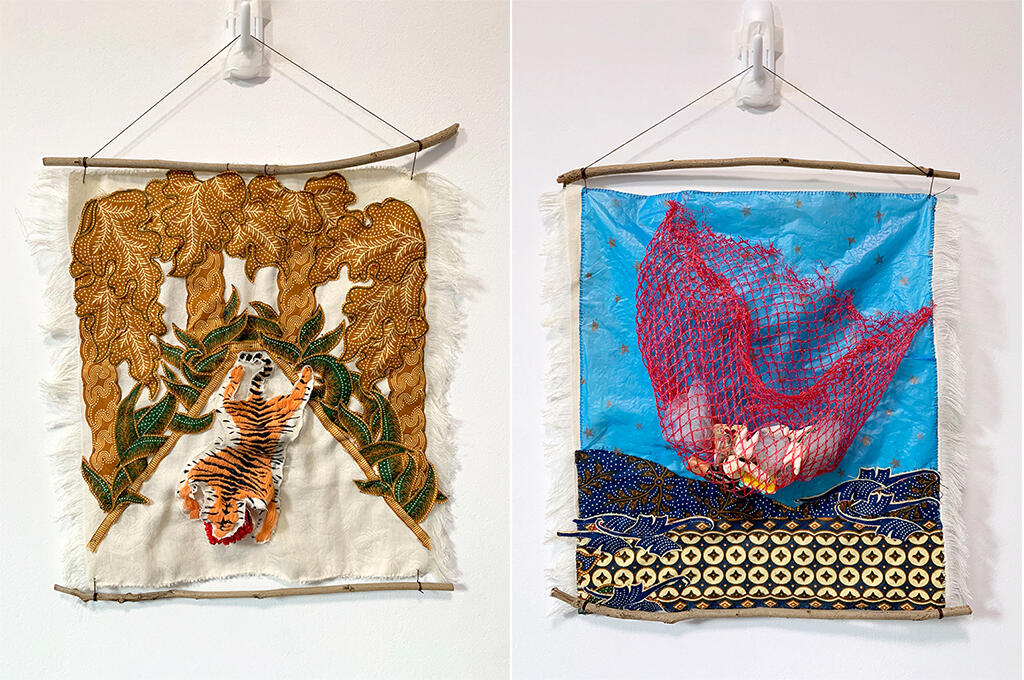
These two pieces were made to complement each other, hence their names: Tanah & Air. I’ve had this image of a tiger pelt in an oil palm plantation—a visual analogy to habitat loss and animal extinction due to deforestation—in my head for a long time, but I was unsure how to execute it. In the end I decided on this mixture of embroidery, appliqué, and assemblage, but using elements that we as Malaysians are more familiar with. The oil palm trees and leaves are made from cut out batik motifs, the oil palm cluster is represented by a kabo bead, a significant culture identifier for the Orang Ulu community. The contrast between the dark subject matter and the bright, almost innocent way it’s portrayed is something that I enjoyed playing with. It reflects that certain blithe ignorance we all face when speaking about the impacts of deforestation or pollution.Air was made using similar methods to Tanah, but with more recycled and repurposed materials: the fishing net is old fruit packaging, the catch of the day being various bits of debris and trash I’ve collected. The composition brings to mind illustrated children’s storybooks, which begs the question: in a hundred years from now, what kind of stories will we be telling our kids about the Earth, the environment, and our role in preserving—or destroying—it? Will these vignettes be our reality one day? Or will they remain cautionary tales?


<< back to Gallery

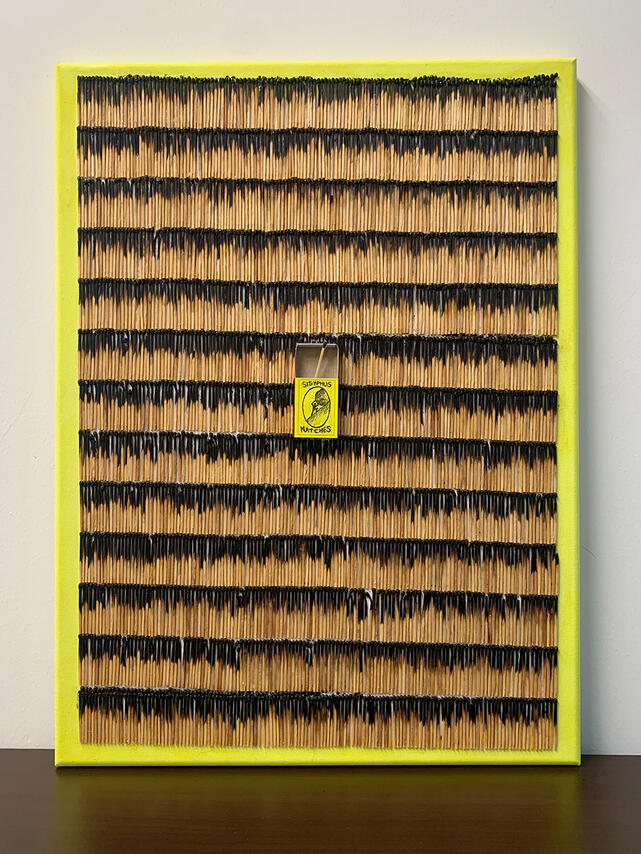
Burning Out But At Least I'm Burning (2023)
Mixed Media, 45cm x 60cm

A spark is seen as a positive thing, but it is also destructive. When a match is struck, it lights up its surroundings, but it sacrifices itself in the process. This piece speaks to that sense of futility and self-destruction that a lot of activists and community builders face. Depending on your interpretation, this piece could be viewed as pessimistic, or as a symbol of hope in the face of adversity. Yes, many sacrifices were made to get here, but there is still one match left. Will you be the next spark of change? It’s your turn now.


<< back to Gallery
take the Virtual Tour >>

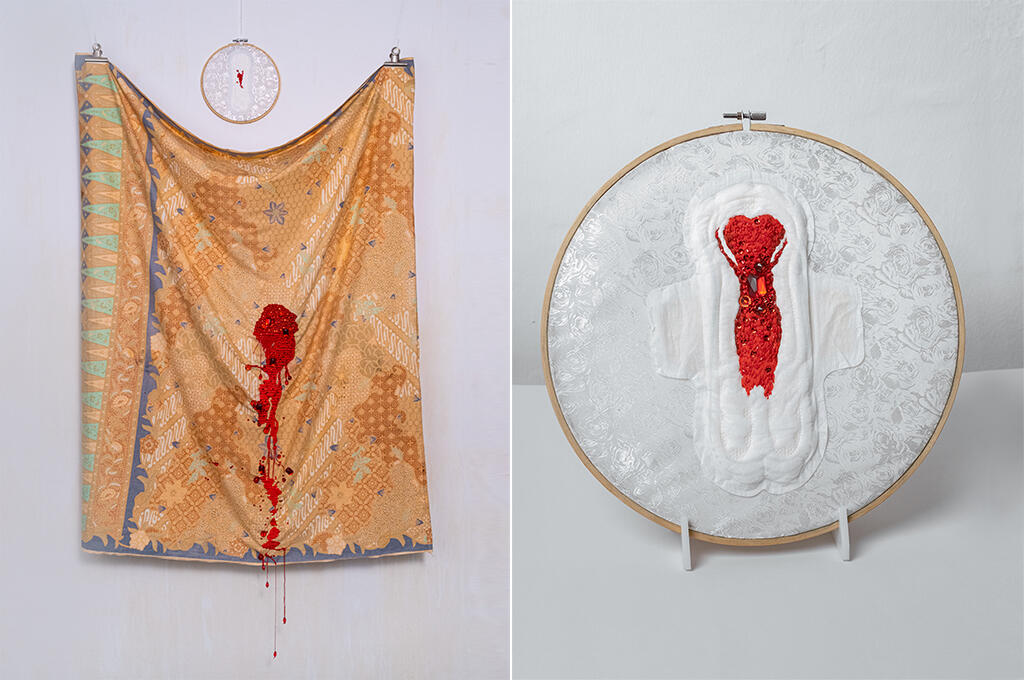
(H)ARUS I
Mixed Media, 18cm diameter(H)ARUS II
Mixed Media, 30cm diameter(H)ARUS III
Mixed Media, 88cm x 108cm


When I think of menstruation, I think of pain, stigma, and shame. I think of how having your period is such an intrinsic part of being human but we can’t speak openly about it because it’s treated with so much disgust by people who don’t even experience it first hand. This series of works aim to confront that perception, to challenge myself and my audience to view menstruation as something essential, even precious; Arus yang Harus, a necessary flow.I chose embroidery as my medium for a number of reasons, one of which is its connotation to “women’s work”: i.e. a sphere of art that has historically been viewed as inferior, trivial, or frivolous compared to more “serious” male-dominated mediums. But mostly I chose this specific technique for how painstaking and tedious it is. With each stitch I gained an appreciation for the process as well as for my body. I wanted it to be a labour of love, a slow and steady unveiling: what was hidden is now seen, what was foreign is making itself familiar, and it is beautiful.


<< back to Gallery

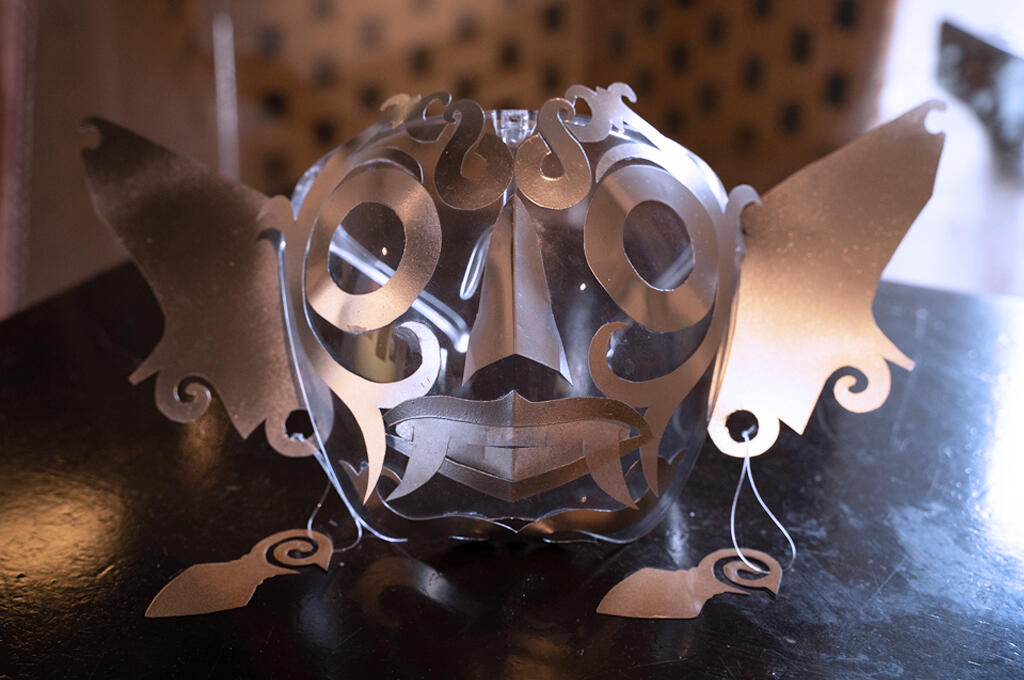
Hudo' I (2021)
Mixed Media, 23cm x 11.5cm x 20cmHudo' II (2022)
Mixed Media, 25cm x 15cm


Hudo’ is the Kayan word for mask, worn by shamans during sacred rituals and ceremonies. These rituals were performed for many occasions and functions—to usher in a good harvest, to appease the spirits before a big event or battle with a warring tribe—and, most fascinating and topical of all, to scare away sickness. Mask as medicine, literally. Hudo’ I was created while we were all still adjusting to the “new norm” of the pandemic, and Hudo’ II was created a year after—the difference in my mental state and attitude while making each of these pieces is readily apparent. The connection of mask as medicine in the post-Covid world is the theme behind both, but they originate from two different perspectives.One, a feeling of claustrophobic powerlessness—bleached of colour, literally trapped, brought low from such a lofty, sacred position—while the other is more lighthearted and playful; a democratisation of mysticism, a reimagining of science as magic. Traditionally, hudo’ was a tool reserved exclusively for shamans (dayung), but now everyone wears a mask; essentially, everyone is their own dayung. Modernity has brought us increased literacy and decentralisation of data, and our old superstitions and belief systems have become obsolete. I was interested in what this intersection of spirituality and science would look like.


Design Work

EVENT GRAPHIC
Word of Mouth:
BorNeon (2025)
ILLUSTRATION
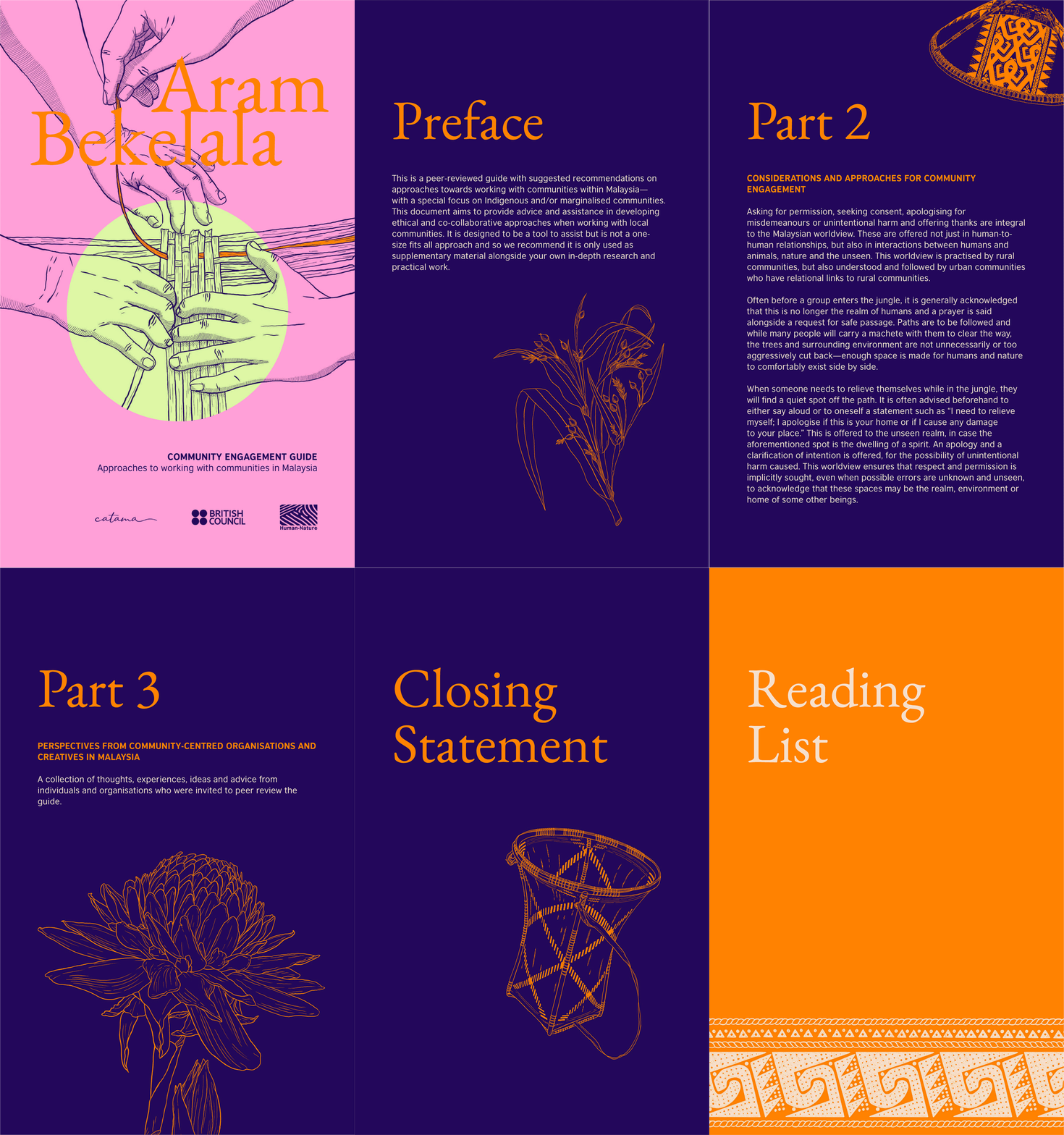
Aram Bekelala (2024)
EVENT GRAPHIC
Word of Mouth: Kembali (2024)
EVENT GRAPHIC
Malaysian National Poetry Slam
Open Mic (2022)
EVENT GRAPHIC
Word of Mouth: Menua (2022)
EVENT GRAPHIC
Big People/Kelunan Aya' (2021)
EVENT GRAPHIC
Making the Cut (2021)
EVENT GRAPHIC
Lingua Franca (2021)



Essays & Poetry
Essay: On the Bakun Dam, and everything that drowned there
“Above a Drowned World, Existence is Resistance”Essay: On code-switching in poetry
“I have four tongues in my head, so please excuse me if I trip over my words”Poetry Anthology: On migration, borders, and how we can reimagine language into a tool for healing instead of violence
“To Dance Along The Wind”
Above a Drowned World, Existence is Resistance
Oct 12, 2023 | By Bethany Luhong Balan
Bayoh Lodge, Kapit, SarawakThe sign says Sungai Asap is 90 kilometers away. I sit up straighter in the backseat of my father’s old Hilux truck—or I try to, at least. The bumpy road jostles me around and I keep bumping shoulders with my sister. I take my phone out, checking the time. I do the calculations in my head. If my uncle keeps driving this fast, we’ll get there in a little over an hour.My parents, my sister, and I are visiting my father’s homestay lodge that he built on the Bakun Dam reservoir. He wants us to check out the progress he’s made. I’m excited and a little bit nervous. My father goes back regularly but I haven’t been back to kampung in a while. Life and work and the sheer distance we have to travel makes it easier to stay behind in Kuching. But the journey is considerably shorter than it was when I was a kid. We don’t have to drive almost twenty hours on untarred roads, or take ferries or express boats anymore.Now, it’s merely a
- fifty-minute flight from Kuching to Bintulu,
- a three-hour drive from the Bintulu airport to our longhouse, Uma Belor (to pick up supplies and any miscellaneous relatives who want to tag along)
- then a forty-five-minute drive to the Bakun Dam jetty,
- and finally a twenty-minute boat ride to the Bayoh Lodge.Easy-peasy, kacang.We manage to reach our destination in one piece, loaded up with wild boar meat, coffee, booze, and an additional two passengers: my grandmother and my great uncle. The lodge is built on the edge of the reservoir, against the shoreline: on stilts over the water, water on three sides, trees on one. We unpack, settle in, and make some food. I check out the accommodations: three rooms, each with its own attached kitchen and bathroom area. All the wooden planks are still untreated but there are curtains in the windows. Rustic chic. A work in progress.I head out to the narrow verandah in the front overlooking the water and see my family already congregating there. There are makeshift benches lining the walls—planks precariously perched on wooden stumps, threatening to upend any overly-enthusiastic storytellers—the perfect spot to eat and drink and chat. In between the eating and drinking and chatting, we go to two waterfalls, one of which my dad says he visited a lot when he was young. The water levels are obviously higher now, but “the rock is still here” he says, pointing to the gigantic boulder that initially concealed the waterfall from view. Back in the day, it took my dad and uncles two to three days to trek to that waterfall from the old longhouse. But from our lodge, it’s less than ten minutes by speedboat, flying across the surface of the water the way birds flew across the sky twenty-five years ago. That always trips me up. That we’re standing—or floating, rather—where the tree canopy used to be.

In the speedboat heading towards the Bayoh Lodge. If you squint, you can see the Bakun Dam structure and embankment in the distance

A view of the Bayoh Lodge from the bank of the reservoir, taken in 2022

The hidden waterfall. The boulder can be seen on the right, and my father is casting his fishing net on the left.

The titular Bayoh leaf, cut from one of the trees on the bank


The water is fresh and cool here, cooler than the water in the dam reservoir, because it comes straight from a mountain stream. I forget to ask what the mountain’s name is, or the stream’s, for that matter. Kayan people have names for every single stream and tributary, and they remember them all. I forget to ask. I forget that my father won’t offer up information unless explicitly asked. I don’t know how much I don’t know, so I don’t know where to start. It’s so frustrating trying to retrace my family tree with clumsy fingers dirty from digging. My people’s history is all right there but I can’t access it; there’s a language barrier and hundreds of meters of water in between us. And sometimes, I simply forget to ask.After the waterfalls, we head back to the lodge. My father and uncle catch some fish and it’s time to eat again. My father named it the Bayoh Lodge after the trees that grow in abundance there. According to my grandmother, Bayoh leaves are medicinal. If you boil the leaves and wrap them around your abdomen, it cures stomach pain.How appropriate, I think, sipping my coffee while I stretch out on the verandah, gazing at the lush scenery all around me, how appropriate for our lodge to be named after a thing that takes away pain.

In 1998, the government relocated my longhouse—along with many others—to Sungai Asap because they wanted that land for the Bakun Dam. I was seven years old at the time, and my memory of the event is hazy at best. They say the relocation was voluntary but we all know what “voluntary” means in this country. The Bakun Dam is 205 meters tall and has a surface area of 695 square kilometres. For contrast, Singapore is 728 square kilometers. Yes, all of Singapore.Last year, I discovered a two-hour-long, twenty-year-old video of my old longhouse. It was like looking at a ghost, like seeing a place from a dream you had a long time ago. It was posted on my cousin’s Facebook page and, as it turns out, was filmed by my father. I was shocked, but at the same time, not shocked at all. He never offers up information unless explicitly asked, and I don’t know if that’s a cultural thing, or a generational thing. Perhaps, as is often the case, it’s a little bit of both. My father was documenting the days leading up to our exodus. He was walking up and down my old longhouse’s wooden verandah, recording the old doors, the old walls, the old land, the old river, the old trees, because that would be the last time any of us would ever see them.In one scene, a pui ake’ (grandfather) was performing a ritual. He was saying goodbye to the land. The video was pixelated and the audio was muffled, but I heard him saying, “We are leaving this place…” and someone from off-screen interjected, yelling: “We’re not leaving, we are running away! We are running away.”It must have been one of my uncles, but I couldn’t recognize his voice, twisted by pain and anger and defeat. The same pain and anger and defeat that has haunted me since I was old enough to understand how things are done in Malaysia.Decades later, my father, along with quite a few of my relatives, returned to Bakun and built floating houses, homestays, and lodges. I guess we got tired of running away.

The surface of the Bakun Dam is a dead zone. How’s that for a metaphor. No telephone signal, and definitely no internet. The only electricity we have is intermittent at best—my uncle jerry-rigs some solar panels and a couple of car batteries together into a rudimentary charging station for our electronics. Kayan people are nothing if not resourceful. “We make do” should be our community motto.The day passes slowly in Bakun. There’s not much to do here for a city girl. My father encourages me to swim in the dam water because “the sulphur is good for you,” he says. That’s cool, I guess. But I never fully relax in the cloudy water, morbidly fascinated by the creepiness of it all. I can’t help but think of all the things that drowned here: calcified trees, animal bones, and empty longhouses, hundreds of meters beneath my floating body. Sometimes bubbles rise up in random places, breaking the eggshell-blue surface of the water. Perhaps it’s the ghosts of deer and ants and civet cats from two decades ago saying hi.As I float, I ruminate. What is the cost of assimilation. What is the cost of progress. Was it worth it? On the one hand, our new longhouse has electricity, running water, an actual asphalt road leading up to it. Luxury! On the other hand, it’s basically empty except for Christmas time. So many of us moved to bigger cities for education, jobs, survival. There’s nothing here for us anymore. We used to be able to live off the land. Now we have land to farm pepper and such, but it’s not profitable enough to sustain all of us. Not enough wild game to hunt, not enough fish in the river that’s so muddy and choppy we don’t even swim in it. After spending a weekend at the Bayoh Lodge, the “new” longhouse feels so…cultivated. You need to drive or walk a ways to meet the jungle: it doesn’t greet you when you open the door anymore. We have been downsized. We have been tamed.But progress marches on, right? Or maybe not. Idle hands and idle minds are a bad combination for the young folks looking for some mischief to get up to. Substance abuse remains a big problem in rural areas. And the dam doesn’t seem to generate much of anything; Sarawak is still one of the most underdeveloped wilayah in the country. The biggest hydroelectric dam in Malaysia is a mere forty-five minutes away from my longhouse, but I don’t feel empowered at all.Assimilation is sacrifice. Assimilation is costly. You pay for your bachelor degree with 200 meters of water flooding your father’s longhouse. You pay for your fluency in bahasa perantaraan with burnt bridges, and now you need an interpreter to talk to your grandmother. But what do you call a sacrifice made unwillingly? Is that not murder? What do you call it when you take (and take and take and take) more than what was agreed upon? Is that not theft?Did you know that some longhouse stilts were made from belian wood? Hard as rock, sturdy as steel. I don’t know if that was the case for my old longhouse. I was so young when we moved to Sungai Asap, and sometimes I forget to ask these things. But I can’t help but picture it: my father’s house under fathoms of water, dark, dead, and empty on its ironwood legs.Was drowning my ancestral home worth it? Was it worth uprooting us and short-changing us on what we were promised? Was it worth an entire generation of Kayan youths having to cosplay as archaeologists just to keep our heritage alive? The answer depends on who you ask, I guess. But Kayan people are nothing if not resilient. “We’re still here” should be our community motto. Despite being uprooted, colonized, converted, and Bangsa Malaysia-nized, we are still here.One question I did remember to ask my father was if he felt worried that the government would punish him for building on the dam—what if they wanted to reclaim the land his lodge sat on, just like they did with our old longhouse. He scoffed and said, no pain or defeat in his voice, but perhaps a little bit of anger: “They can try!”They can try. But we’ll still be here. Existence is resistance, and we are still here.© Bethany Luhong Balan
Commissioning editor: Anna Tan
Originally published on ThisIsSoutheastAsia.com